The Microbiome’s Interpretation Problem

Modern microbiome research has moved far beyond simple cataloging of which microbes are present in a sample. Today, researchers can interrogate microbial communities across multiple layers of biology. Metagenomics offers insight into genetic potential. Metatranscriptomics reveals which genes are being actively transcribed. Metaproteomics identifies translated proteins. Metabolomics captures the chemical products emerging from microbial and host metabolism.
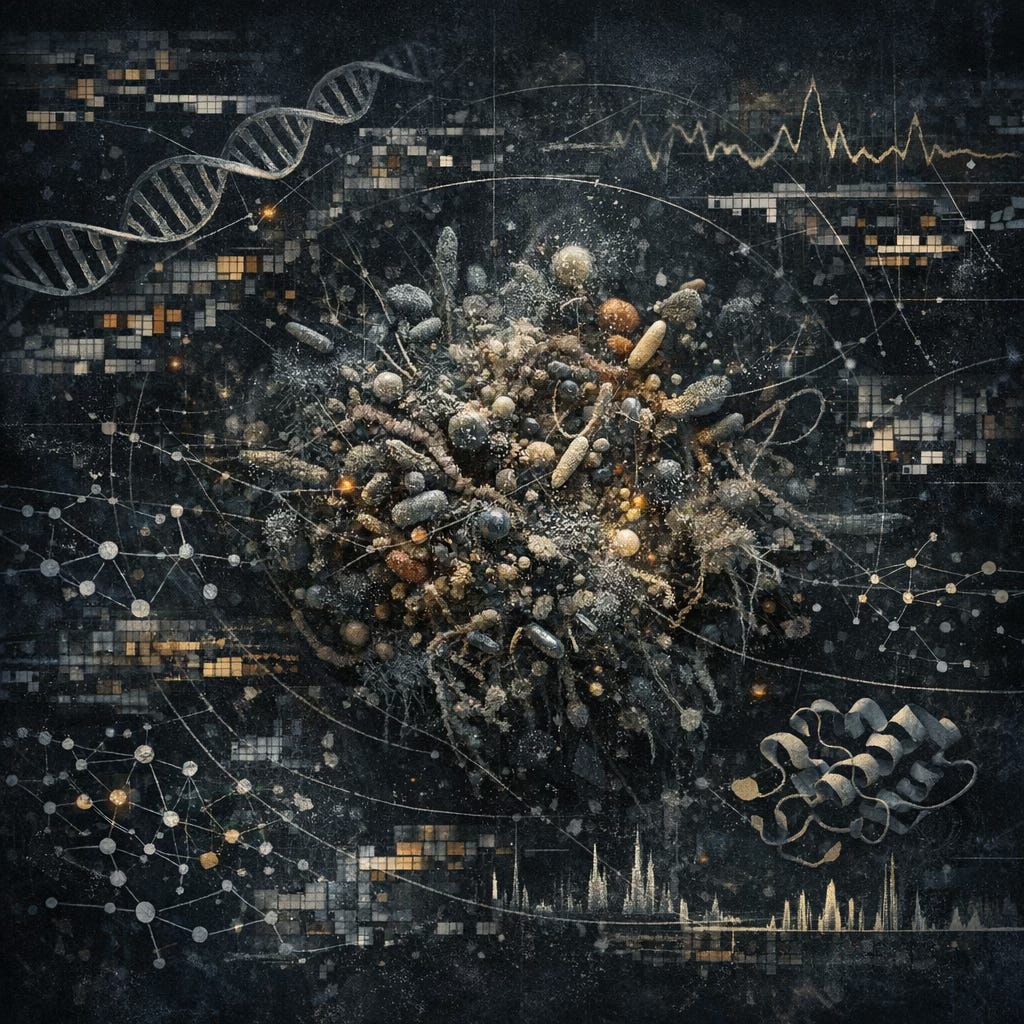
Taken together, these tools promise something the field has wanted for years: a way to move beyond “who is there” toward “what are they doing?”
That promise is real. But so is the problem.
The major challenge in microbiome science is no longer just generating data. It is interpreting increasingly complex, heterogeneous, and often incomplete datasets in a way that supports defensible biological conclusions.
In other words, the microbiome field does not simply have a measurement problem. It has an interpretation problem.
Multi-omics did not simplify the field. It made the real complexity visible
For years, one of the most obvious limitations in microbiome research was the gap between taxonomic description and biological function. Knowing that a microbe is present does not mean it is active. Knowing a gene exists does not mean it is expressed. Knowing a pathway is encoded does not mean it is contributing meaningfully to host physiology.
Multi-omic approaches were supposed to close that gap, and in many ways they have.
We can now measure transcriptional activity, protein production, and metabolic outputs alongside microbial composition. That is a major advance. But rather than producing simple mechanistic answers, these approaches have exposed how biologically messy microbial ecosystems really are.
Gene expression does not always predict protein abundance. Protein detection does not always reflect activity. Metabolites may come from microbes, the host, diet, or some interaction among all three. Many functions are distributed across multiple members of a community rather than being attributable to a single organism.
The result is more biological visibility, but not necessarily more interpretive clarity.
The first problem is integration
Each omics platform captures a different biological layer, and each comes with its own scale, biases, noise structure, and technical limitations. These datasets are not naturally plug and play.
DNA sequencing, RNA sequencing, proteomic profiling, and metabolomic analysis differ in sensitivity, dynamic range, missingness, and statistical power. Sample handling differences can introduce variation before the data are even generated. Extraction methods, sequencing platforms, library preparation, and analytical pipelines all shape the final result.
That means integration must involve computational, biological and methodological integration.
It is easy to line up multiple -omics layers in a figure. It is much harder to determine whether those layers are truly telling a coherent story or simply reflecting parallel but only partially connected signals.
Computational frameworks like MOFA, mixOmics, and gNOMO are important steps toward integrating these data. But no algorithm can rescue a weak study design or resolve biological ambiguity that the underlying data cannot support.
The second problem is statistical reality
Microbiome data do not behave nicely.
They are compositional, sparse, high-dimensional, and full of missing values. Those characteristics break many assumptions built into conventional statistical approaches.
Compositionality alone creates major interpretive problems. Relative abundance data are constrained, which means apparent changes in one feature can arise simply because others have shifted. Without careful handling, this can generate misleading correlations and false biological narratives.
Then there is the classic p much greater than n problem. Microbiome datasets often contain enormous numbers of variables relative to the number of samples. Add in sparsity, where many features are absent or undetectable across samples, and it becomes difficult to distinguish true biological absence from technical limitation.
Now layer on incomplete sampling across multiple omics platforms. Some samples have transcriptomic data but no proteomics. Others have metabolomics but poor sequencing depth. Missingness becomes a structural feature of the dataset, not a minor inconvenience.
At that point, analysis becomes a balancing act between signal detection and statistical self-deception.
The third problem is biology itself
Even if the technical and statistical issues were solved perfectly, biological interpretation would still be hard.
Microbial ecosystems are not collections of isolated actors. They are distributed systems shaped by ecological relationships, cross-feeding, competition, host immunity, nutrient availability, medication exposure, and diet. Multiple species may contribute to the same pathway. Taxonomic shifts do not always translate into functional shifts because of redundancy within the community.
This is one reason causality remains so difficult.
Multi-omic studies can reveal strong associations between microbial features and disease states, but distinguishing cause from consequence is still a major challenge. Is a metabolic signature driving disease, responding to disease, or simply traveling alongside another process that matters more?
That question gets even harder when many metabolites remain unidentified, when protein annotations are incomplete, and when reference databases are still missing large portions of microbial diversity. The field still deals with a substantial amounts of microbial dark matter, especially in metabolomics and proteomics, where unknown peaks and poorly annotated features can limit interpretation.
So yes, the data may look richer. But richness without interpretability is not the same thing as understanding.
Batch effects are not a side issue
One of the biggest traps in multi-omic microbiome research is treating batch effects as a technical nuisance instead of a central scientific threat.
Batch effects can be introduced at nearly every stage. Collection, storage, extraction, sequencing, mass spectrometry, preprocessing, normalization, and downstream analysis each come with their own set of potential confounders. Once layered across multiple platforms, those effects can become deeply entangled with the biological signal.
That is how you end up with beautiful integrated plots that are statistically elegant and biologically misleading.
This is why careful experimental design matters. Reproducibility in microbiome multi-omics depends on better algorithms, but it also depends on disciplined planning before the first sample is ever collected.
The future of the field depends on interpretive discipline
The answer is not to back away from multi-omics. Quite the opposite.
These approaches are essential if microbiome science is going to move toward mechanism, intervention, and translation. Personalized medicine, biotechnology, and agricultural applications all depend on understanding not just which microbes are present, but how microbial ecosystems function under specific conditions.
But the field needs to be honest about what multi-omics does and does not solve.
It gives us more layers of evidence. It does not automatically give us causal inference. It gives us a richer biological context. It does not guarantee a clean mechanistic story. It gives us more sophisticated measurements. It also gives us more ways to overinterpret noise.
The next phase of microbiome science will belong to researchers who can integrate these datasets rigorously, design studies thoughtfully, control technical variation aggressively, and resist the urge to tell a stronger story than the biology supports.
That is where the field’s real bottleneck is now.
Not data generation.
Interpretation.
In the next essay, I’ll examine why the field is increasingly turning to artificial intelligence, machine learning, and digital twin models to solve this problem, and why I’m not convinced that rushing in that direction will produce the clarity many people expect.