Probiotic Autopsy: VSL#3

VSL#3 is one of the better-known probiotic products on the market. It lists multiple organisms, provides a substantial total CFU count, includes storage instructions, and guarantees potency through expiration.
That sounds reassuring.
Then you look more closely.
I ran the product through the new Guttitude Probiotic Decoder, which evaluates what a label actually tells a buyer about organism identity, dose, evidence traceability, testing, and marketing claims.
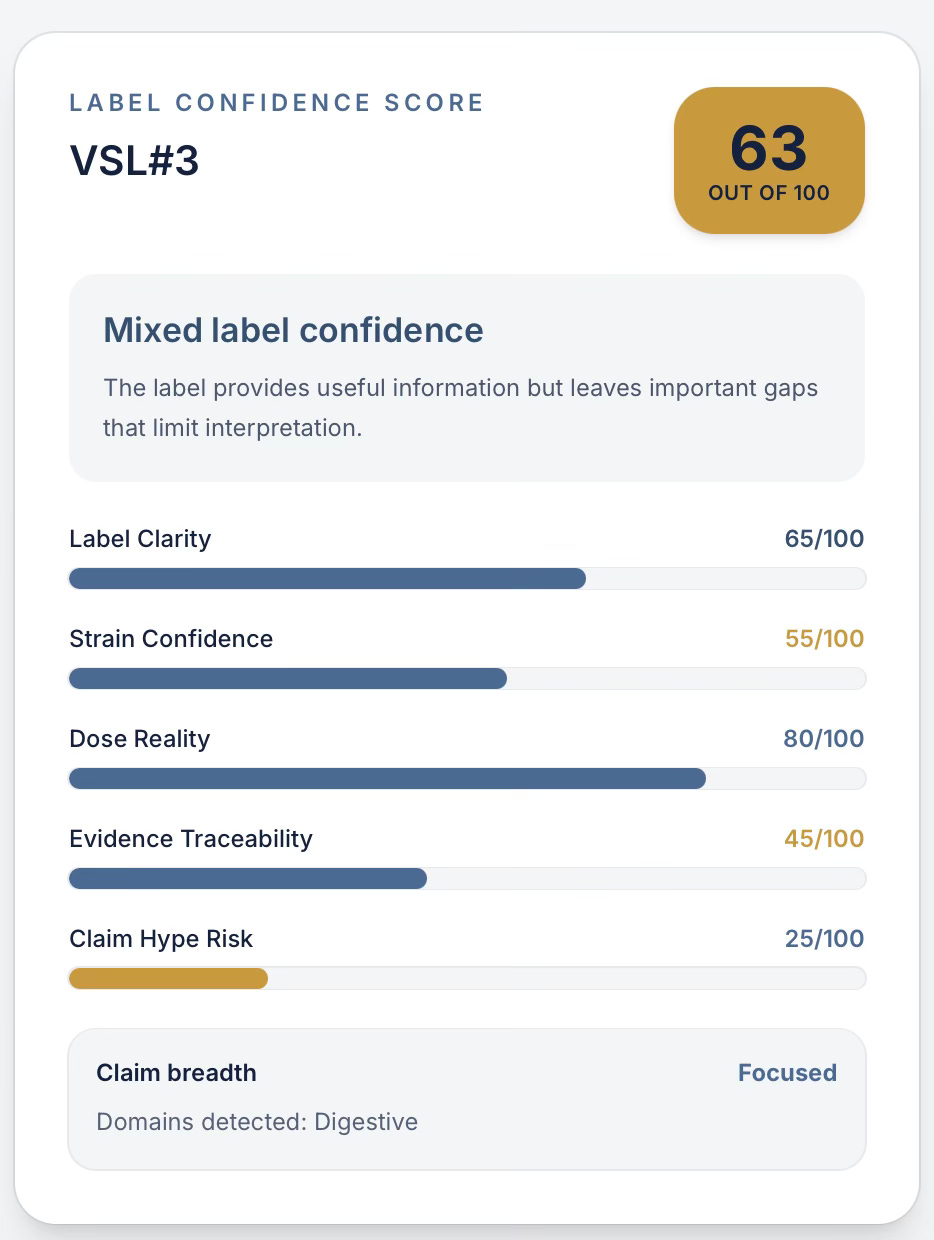
Overall label confidence score: 63 out of 100
That lands in the “mixed confidence” range.
The label does several things well:
• It lists the organisms
• Seven species-level entries were detected across three genera
• The total CFU amount is provided
• CFU is guaranteed through expiration
• An expiration date is listed
• Storage instructions are clear
Those are meaningful strengths. A potency guarantee through expiration is much more useful than a count measured only when the product leaves the factory.
But the autopsy also found several important gaps.
Seven species. Zero strain identifiers.
That is the biggest limitation.
Probiotic effects are often strain-specific. Two organisms from the same species can behave differently, produce different metabolites, interact differently with the host, and produce different outcomes in clinical studies.
A species name can narrow the search. A strain identifier lets you trace the organism to actual evidence.
Without strain IDs, a buyer cannot easily determine whether the organisms in the bottle match the organisms used in published studies.
The label also provides a total CFU count without breaking that amount down by strain.
That means you know the size of the crowd, but you do not know who is in it or how many of each organism showed up.
The decoder gave VSL#3 an 80 out of 100 for dose reality, largely because the total CFU is listed and guaranteed through expiration.
Its evidence traceability score was only 45 out of 100.
That does not mean the product has no evidence behind it. It means the label does not provide enough detail for a consumer to easily connect the commercial product to specific organisms, doses, studies, and outcomes.
The label also did not report third-party testing or certification.
That leaves several practical questions:
• What are the complete strain identifiers?
• How much of each strain is present?
• Is the finished product independently tested for identity, potency, viability, and contamination?
• Does human evidence exist for this exact formulation, dose, population, and intended use?
• Does the product currently sold match the formulation used in the cited research?
That last question is especially important for legacy probiotic brands. A familiar name can persist even when manufacturing arrangements, formulations, ownership, or evidence references become complicated.
The verdict?
VSL#3 provides more useful label information than many vague probiotic products. Its expiration-based CFU guarantee and clear organism list are genuine positives.
But it still asks the buyer to accept a substantial evidence gap.
The label tells you the species and the total crowd size. It does not fully tell you which strains are present, how the dose is distributed, or how directly the bottle in your hand can be connected to the research.
That is the difference between having scientific language around a product and being able to trace a product to science.
The Guttitude Probiotic Decoder does not decide whether a probiotic will work for you. It identifies what the label supports, what remains unclear, and which questions deserve answers before you spend money.
Because “contains billions of bacteria” is not the same thing as “provides enough information to evaluate the product.”
Would you buy it based on this label?
guttitude launches Thursday, June 18.
guttitude is a gut-health education and decision-support platform for people who want clearer answers about food, probiotics, supplements, microbiome tests, and wellness claims.
One of its core tools is GutSense, which lets you log food, exercise, sleep, meditation, and other daily habits. GutSense uses those inputs to model how the pattern may support or pressure different microbial groups and functions, including fiber fermentation, butyrate production, cross-feeding, mucus ecology, and inflammatory pressure.
It is not a microbiome test and does not measure which bacteria are actually present in your gut. Instead, it helps you explore how the foods and habits you log could shape a microbiome based on current scientific evidence. Think of it as a model of the intestinal environment, not a stool-test result.
guttitude also includes the Probiotic Decoder, evidence-based product scorecards, microbiome claim checks, and tools that help separate useful science from marketing fog.
The goal is simple: make gut-health science practical, transparent, and harder to misuse.
guttitude goes live Thursday, June 18.