Every Probiotic Label Should Answer These Five Questions. Most Don’t.

The probiotic aisle is built to make you feel underinformed.
The labels are crowded. The organisms have long names. The numbers are enormous. The claims are fuzzy enough to sound medically important without saying anything medically specific.
“Supports digestive health.”
“Helps restore balance.”
“Promotes a healthy microbiome.”
“Backed by science.”
Backed by which science?
That is where the label suddenly becomes shy.
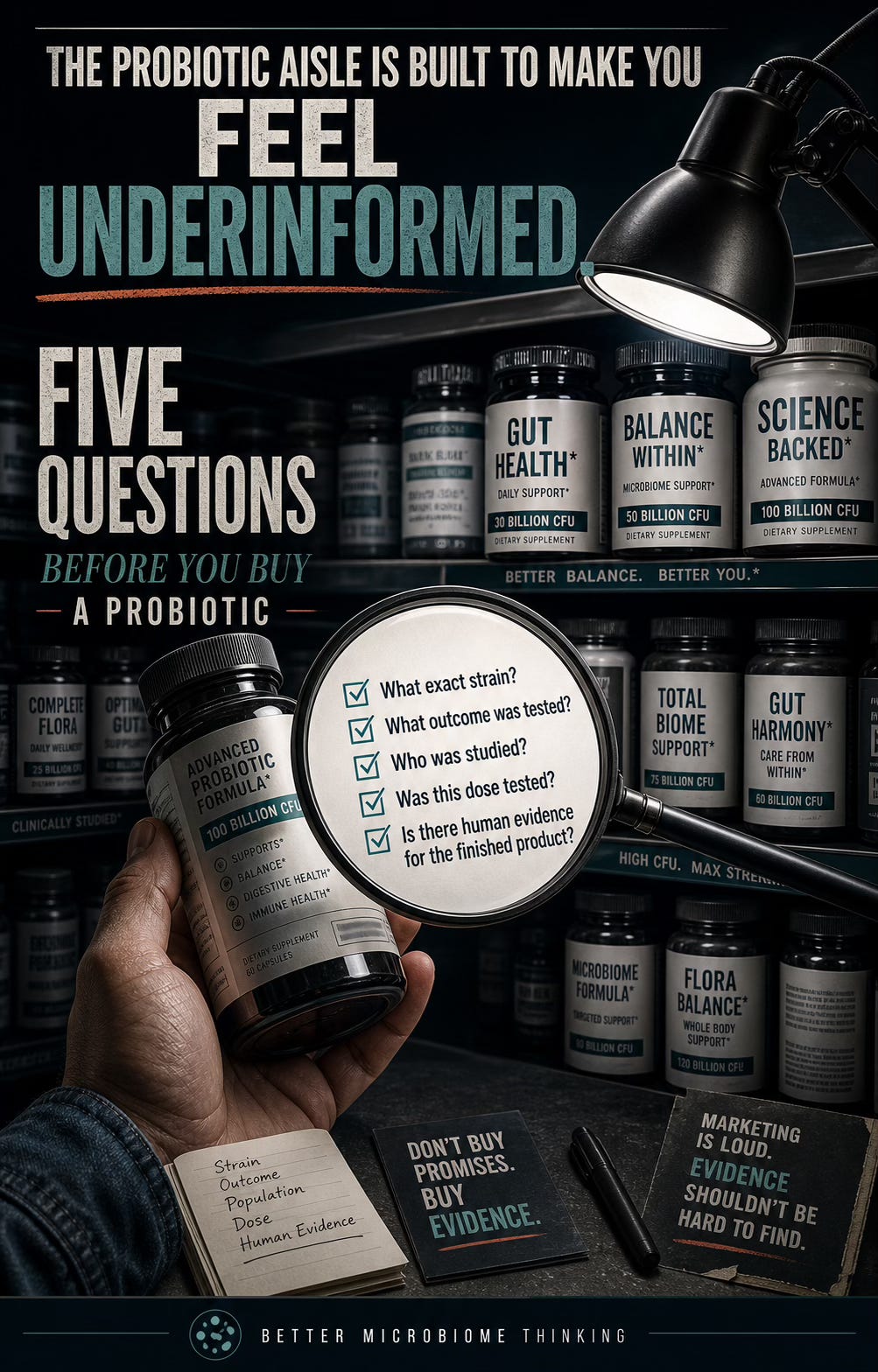
Most people do not need a PhD in microbiology to make better decisions about probiotics. They need five questions.
If a product cannot answer them clearly, it has not earned your money.
1. What Is the Exact Strain?
Not the genus, not the species and not a trademarked blend name that sounds like it was invented in a startup brainstorming session involving kombucha.
The strain.
A useful label should identify the organism precisely. That often means a genus, species, and strain designation.
For example, a label that says Bifidobacterium longum is incomplete. A label that identifies a specific strain gives you something that can actually be traced back to published evidence.
This matters because probiotic effects are usually strain-specific.
One strain may have evidence for one outcome. Another strain from the same species may do something different. Or nothing clinically useful at all.
“Contains Lactobacillus” is not enough information to evaluate a product.
It is a category label, not a scientific argument.
2. What Was It Actually Tested To Do?
“Gut health” is not an outcome.
“Microbiome balance” is not an outcome.
“Immune support” is often a cloud wearing a lab coat.
A product should tell you what it was tested to do in people.
Did it reduce the risk of antibiotic-associated diarrhea?
Did it improve constipation frequency?
Did it change bloating in people with a specific diagnosis?
Did it improve a clearly measured immune outcome?
The more specific the claim, the easier it is to evaluate.
The vaguer the claim, the more likely you are being asked to supply the confidence yourself.
A supplement company should not get to borrow the seriousness of clinical medicine while refusing to name the clinical outcome.
3. Who Was Studied?
Evidence is not portable by magic.
A product studied in healthy adults may not have evidence in people with irritable bowel syndrome. A product studied in infants may not tell you anything about older adults. A product tested during antibiotic use may not be relevant to someone taking it for “daily wellness.”
The study population matters.
So does the setting.
So does the duration.
So does the actual problem people were trying to solve.
This is where a lot of probiotic marketing gets slippery. A company points to a study involving a related organism, a different dose, a different product, or a completely different population and hopes nobody notices.
Notice.
The question is not whether a probiotic has ever helped someone somewhere.
The question is whether this product has evidence for someone like you, for the thing you are actually trying to improve.
4. Was the Dose and Product Formulation Tested?
A dose is not automatically meaningful because the label printed a large number next to it.
Ten billion CFUs does not beat one billion CFUs simply because ten is bigger than one.
Different strains have been studied at different doses. Some formulations are designed to survive storage or stomach acid better than others. Some organisms are more stable in a capsule than in a powder. Some products may be viable when manufactured and much less viable months later.
The relevant question is not “How many billions?”
It is:
“Did researchers test this strain, at this dose, in this formulation?”
That is the evidence chain.
Break enough links in that chain and you no longer have a clinical intervention. You have an educated guess in a capsule.
5. Is There Human Evidence for the Finished Product?
This is the question that makes marketers sweat.
Many companies can point to interesting studies on a species, a strain, a metabolite, a mechanism, or a distant cousin of what is in their product.
That is not the same as evidence for the finished product you are holding.
A credible company should make its human studies easy to find. It should identify the formulation used. It should explain the outcome. It should acknowledge limits.
If you have to excavate the evidence from a white paper, a retailer page, a webinar transcript, and a PDF with a file name like FINAL_FINAL2_revised.pdf, the company is not making transparency a priority.
That tells you something.
A Better Standard for Buying Probiotics
You do not need to reject all probiotics.
You need to stop rewarding companies for making the evaluation impossible.
Before you buy, ask:
What exact strain is this?
What outcome was it tested to improve?
Who was studied?
Was this dose and formulation tested?
Is there human evidence for the finished product?
A product that can answer all five questions has earned a closer look.
A product that answers none of them has earned skepticism, no matter how beautiful the packaging is.
The microbiome is complicated.
That does not mean the buying decision has to be mystical.
You are not looking for the most bacteria.
You are not looking for the most expensive bottle.
You are not looking for the product with the happiest shade of green.
You are looking for a clear question and credible evidence that a specific intervention can help answer it.
That is a much higher bar.
It should be.
Want help evaluating a specific product? Use the guttitude Probiotic Decoder to break down strains, claims, evidence quality, and the fine print companies hope you skip.
A lot of these apply to “prebiotic” products as well!
Great stuff, thank you. One question: what about fermented vegetables? Do they always contain roughly the same microbial species to achieve fermentation, or does the microbial composition vary depending on the vegetables and the fermentation process? And from a gut health perspective, would fermented vegetables generally be a better option than probiotic supplements?